A customer asks to cancel a personal-care gift set while the warehouse is picking it. The CX team sees the request; the picker may still be working. In this hypothetical example, acknowledging the customer is straightforward. Confirming that the order will not ship requires a different answer—from the person who can verify and control the warehouse work.
Shopify’s documentation makes one boundary explicit: “A cancellation request doesn’t change the order’s state on its own. You review and decide on every request.”[1] Treat the request as the start of a decision, not evidence that fulfillment has stopped.
For an ecommerce operations leader, the practical question is who closes the gap between the customer’s request and the warehouse’s confirmed state. A cancellation decision and a physical stop need their own evidence. Neither should be inferred from the other.
Keep three answers separate
Use your existing order and warehouse records to answer three questions:
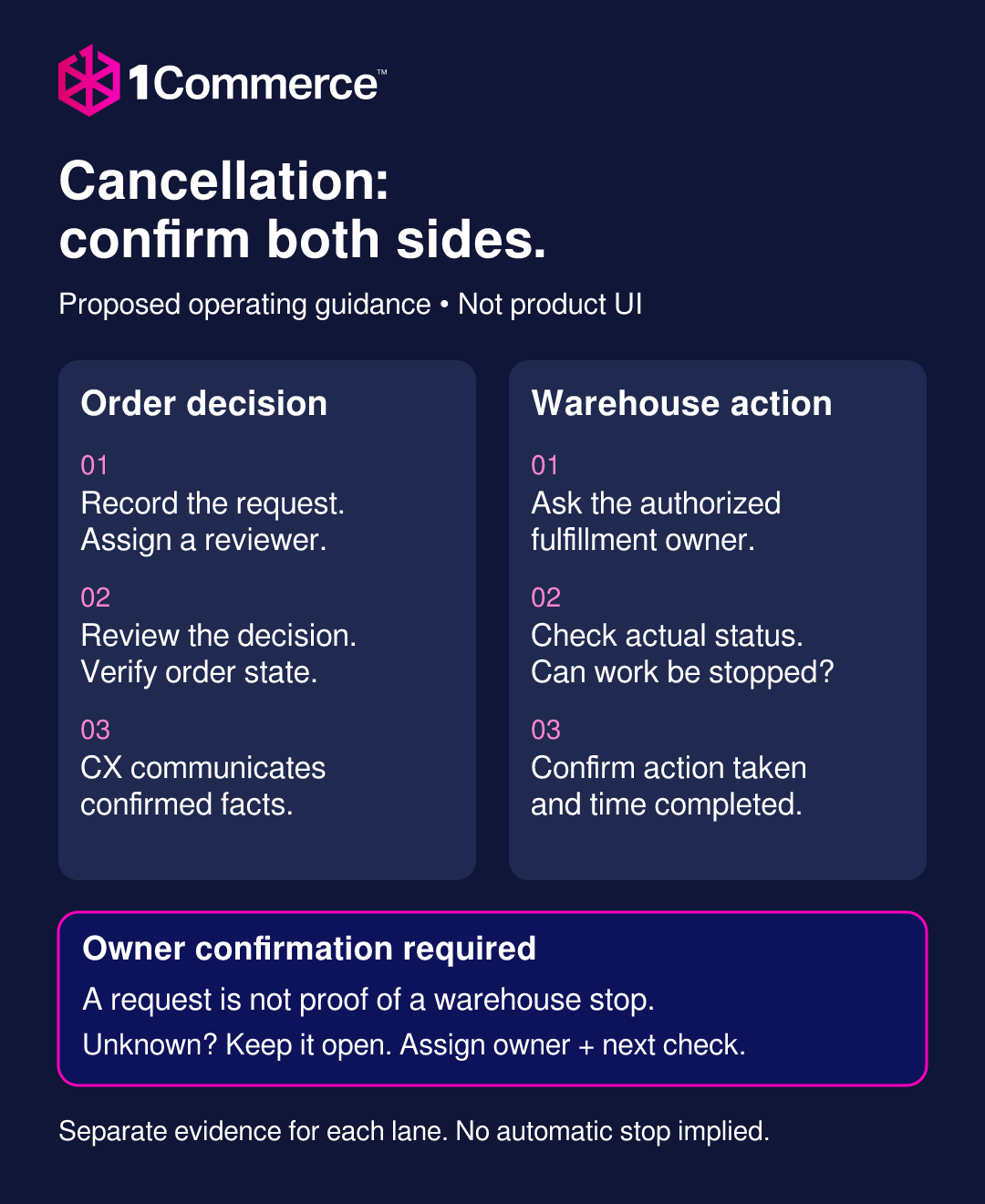
- What did the customer request? Identify the order, affected items and time received. Assign a reviewer so the request is not left between queues.
- What can operations confirm now? Ask the authorized fulfillment owner for the actual work status and whether a stop can still be carried out through the established process.
- What can CX tell the customer? Communicate the decision and any confirmed action, without describing an unverified warehouse stop as complete.
These are proposed operating controls, not Shopify features or an integration specification. This article does not establish that a request reaches your warehouse system, pauses a pick or intercepts a parcel.
Give the handoff a receipt
A short record can make the unresolved decision visible without introducing another application. Use the team’s existing authorized working system.
| Handoff | Owner to identify | Evidence to retain |
|---|---|---|
| Request received | Cancellation reviewer | Order and items requested, receipt time |
| Warehouse check | Authorized fulfillment owner | Observed work status, time checked, whether a stop is still possible |
| Action confirmed | Person responsible for the warehouse action | What was actually done and when; unresolved items explicitly marked |
| Order decision and customer reply | Authorized order reviewer and CX owner | Decision, verified order state and wording sent to the customer |
A message saying “please stop this order” records an instruction, not its completion. Require a return confirmation that names the order and the action taken. If the answer is unknown, keep the warehouse step open and give it a responsible owner and next check time.
Do not substitute a presumed cutoff for an observed state. Your operation needs its own documented decision path for work that is still stoppable, work already beyond that point and work whose status cannot yet be confirmed. The table does not set a universal cancellation deadline or decide anyone’s legal rights.
Work through the hypothetical gift-set request
The reviewer records the request and asks the fulfillment owner to check the gift set’s actual status. While that check is unresolved, CX can acknowledge receipt without promising that shipment has been prevented.
If the authorized warehouse owner confirms a stop has been carried out, the order reviewer still needs to verify the relevant order action and state before CX sends a final confirmation. A warehouse stop alone is not proof that the order record has been updated.
If the owner reports that the parcel has already left, or cannot verify its location, the reviewer follows the business’s applicable escalation process. Do not invent a successful interception or treat a missing reply as agreement. This is a fictional illustration of the handoff, not a customer result or a guarantee that a cancellation can be completed.
Keep configuration separate from the operating decision
This is not a guide to enabling cancellation requests by market. Store eligibility and market-specific settings need a separate check; this article makes no claim that a particular store can enable them. Have the existing authorized owner check the current documentation and the store’s actual setup before changing settings. Do not infer eligibility—or customer rights—from this handoff method.
Start with one cancellation request and trace both sides: the order decision and the warehouse action. Close each only when its owner has supplied the evidence. That gives CX a grounded answer instead of a promise based on an unfinished handoff.
Source
[1] Shopify Help: Setting up self-serve returns and cancellations. Publication date not supplied; retrieved November 12, 2026. Relevant sections: Considerations and Activate self-serve returns and cancellations by market. Retained public documentation, not a merchant-account or warehouse-system test.