
Order Operations
A fulfillment batch needs an exception path, not just a pick list
Keep batch membership separate from fulfillment status. Use an order-level exception checklist for Shopify batch fulfillment, scans and handoffs.
THE OPERATOR’S BLOG
Original guidance on connected commerce, marketplace growth, fulfillment and the operating choices behind channel performance.
Order Operations
Keep batch membership separate from fulfillment status. Use an order-level exception checklist for Shopify batch fulfillment, scans and handoffs.
Catalog Operations
Review Shopify GTIN suggestions against SKU, variant and pack evidence before accepting changes. Use an owner-led checklist for uncertain records.
Managed Commerce
Trace return-window overrides and policy changes to the original order, then keep eligibility evidence separate from warehouse inspection.
Managed Commerce
Use a variant-level evidence card to check compare-at values, sharing settings, Catalog preview and the observed shopper price.
Inventory operations
Reconcile Shopify purchase-order populations, row keys and date fields with a practical checklist and a hypothetical 120-unit order split across two shipments.
Fulfillment
Work backward from your warehouse dispatch to review, pick/pack and intake times before advertising a 2026 holiday order cutoff.
Managed Commerce
Review Shopify session measurement changes with a practical comparison card for definition boundaries, coverage limits and post-update reporting.
Inventory & Fulfillment
Audit peak shipping exposure by package, service eligibility, package data, decision owner, and billed outcome.
Inventory & Fulfillment
Define available-to-promise from eligible stock, commitments, buffers and expected supply without confusing it with what is physically on hand.
Marketplaces & DTC
Translate delivery, cancellation, tracking and returns promises into measurable cutoffs, owners and exception responses.
Managed Commerce
Use a 90-day planning horizon to sequence discovery, controls, pilots and evidence while keeping launch timing conditional.
Managed Commerce
Make commerce metrics comparable by documenting numerator, denominator, event timestamps, exclusions, source and known limits.
Managed Commerce
Assign accountable decisions, responsible operators, consulted specialists and informed stakeholders across commerce workflows.
Managed Commerce
Compare commerce partners on actual work scope, integration evidence, exception ownership, controls and commercial clarity.
Returns & Customer Experience
Build an escalation matrix around risk, decision authority, evidence, response coverage and a clear return path to frontline care.
Inventory & Fulfillment
Plan risk-based cycle counts, investigate variances and correct inventory without turning every discrepancy into an unexplained adjustment.
Marketplaces & DTC
Share inventory visibility across DTC and wholesale while preserving distinct allocations, documents, packing and exception ownership.
Order Operations
Design commerce integrations so transient retries do not create duplicate orders, shipments, reservations or customer messages.
Inventory & Fulfillment
Compare inventory at equivalent scope and time, classify differences and repair the owning record instead of forcing totals to match.
Inventory & Fulfillment
Define reservation lifecycle, allocation priority and last-unit behavior so concurrent orders cannot claim the same inventory.
Order Operations
Measure inventory freshness end to end, contain stale channels and recover without replaying obsolete quantity updates.
Marketplace Operations
Diagnose listing errors from destination evidence, correct the responsible layer and reprocess only the affected scope.
Marketplaces & DTC
Run account-health reviews with current channel evidence, root-cause ownership and bounded corrective action—without policy guarantees.
Marketplaces & DTC
Select a marketplace pilot assortment by testing listing readiness, supply, economics and operational exception load.
Marketplace Operations
Map internal categories to changing marketplace taxonomies with versioned decisions, attribute checks and destination-level verification.
Order Operations
Define evidence-based cancellation cutoffs so channels, service teams, OMS and warehouses know when work can still be stopped safely.
Order Operations
Define order states, transitions and handoff evidence so commerce, OMS, warehouse and service teams describe the same operational truth.
Order Operations
Route orders by hard eligibility before optimizing cost or speed, with explainable decisions and controlled overrides.
Marketplaces & DTC
Prepare peak operations with demand scenarios, inventory and labor limits, carrier evidence, decision rights and exception coverage.
Catalog Operations
Translate product data into channel-specific fields with explicit semantics, validation, ownership and a recoverable mapping process.
Catalog Operations
Turn product-content review into measurable acceptance checks for facts, variants, images, channel rules and recovery ownership.
Catalog Operations
Model parent products, sellable variants and packaging levels so identifiers, inventory and channel listings remain unambiguous.
Marketplaces & DTC
Prepare a promotion as a cross-functional change with price evidence, inventory limits, capacity checks and a recovery path.
Returns & Customer Experience
Reconcile approved refunds to channel, payment, order and return records without confusing an instruction with settlement.
Inventory & Fulfillment
Build a replenishment review around usable demand, supply uncertainty, inventory position and explicit operator decisions.
Returns & Customer Experience
Turn customer-selected reasons, inspection evidence and sales denominators into focused catalog, fulfillment or product actions.
Returns & Customer Experience
Decide whether a returned item can be restocked, repaired, routed or disposed while preserving inspection and inventory evidence.
Returns & Customer Experience
Triage returns by matching the order, applying the right policy, routing the item and preserving evidence through inspection.
Catalog Operations
Define who may create, change and retire SKUs so every channel receives the same sellable identity without overwriting operational truth.
Order Operations
Evaluate split shipments using service, inventory, cost and customer-impact evidence instead of a single blanket rule.
Inventory & Fulfillment
Control quantity, identity, condition and release evidence so an inbound receipt does not become inaccurate sellable inventory.
Returns & Customer Experience
Answer where-is-my-order contacts with event evidence, honest status language and escalation based on the shipment's actual state.
Operating Economics
Build an operating contribution view that includes selling fees, fulfillment, shipping and returns, with an editable worksheet and worked example.
Fulfillment
Evaluate a hybrid fulfillment model with clear routing rules, inventory ownership, return destinations and exception handling across locations.
Connected Commerce
Compare software, fulfillment and managed commerce by operational ownership, exception handling and measurable scope before choosing a partner.
Channel Growth
Prepare a marketplace launch with catalog checks, inventory rules, test orders, fulfillment evidence and a clear go-live decision.
Connected Commerce
Follow a product from catalog to return and learn where PXM, OMS and WMS connect, who owns each handoff, and what to test before launch.
Inventory Operations
Separate on-hand stock from sellable availability, set channel allocation rules, and test the inventory exceptions that cause overselling.
Strategy
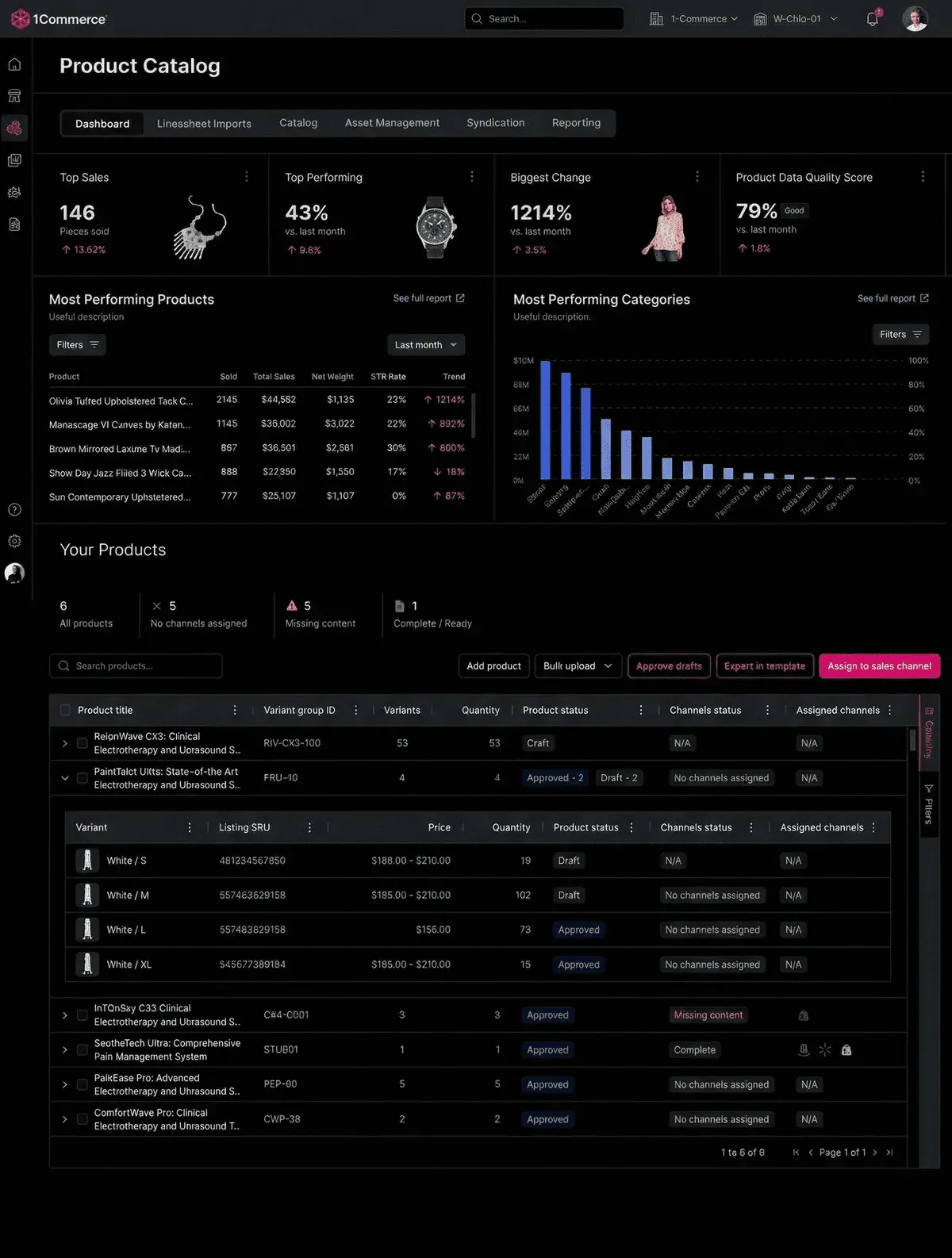
Meet the operator-built platform designed to stop margin leaks and accelerate channel launches.
No results found. Try another search or category.
Analytics is on by default for this visit. You can turn it off in Analytics settings under Privacy.
We use Google Analytics to understand how visitors use our website and to improve it. Depending on your location and applicable requirements, analytics is either enabled by default with an option to turn it off, or begins only after you choose to allow it. You can change your choice at any time through Analytics settings. We honor saved analytics rejections and Global Privacy Control signals by keeping analytics off. We do not use this setup for advertising personalization.
Privacy policyHow Google uses information from sites that use its services
Analytics is off.