A buyer offers to take a slow-moving inventory lot off your hands. The payment would free cash for the next purchase order. The uncomfortable question is where those products might appear afterward—and what that means for the retailers still selling your current assortment.
For the reseller on the other side, the question is just as practical: can this inventory be documented, listed accurately and sold through a workable marketplace route at a margin worth the risk?
Both businesses need answers before the stock moves. Treating every discounted product as evidence of brand failure makes those answers harder to find. So does treating every genuine product as automatically eligible for every marketplace.
Our view: secondary trade deserves a place in channel planning. Brands should distinguish the routes they deliberately supply from subsequent resale they do not direct. Resellers should evaluate the evidence and destination alongside the purchase price. Neither side benefits from a plan built on pretending the other does not exist.
Off-price has more than one supply model
TJX provides a useful starting point because it describes its own sourcing. On its How We Do It page, updated June 2026, the company identifies department-store cancellations, manufacturer overproduction and end-of-season closeouts among its buying opportunities. It also says some merchandise is manufactured for it and some is designed by its own fashion experts.[1]
Those are different commercial arrangements. A product deliberately made for an off-price retailer is not the same proposition as a brand’s surplus stock finding a second buyer. Nor does TJX’s account establish how any particular brand or item reached a particular store.
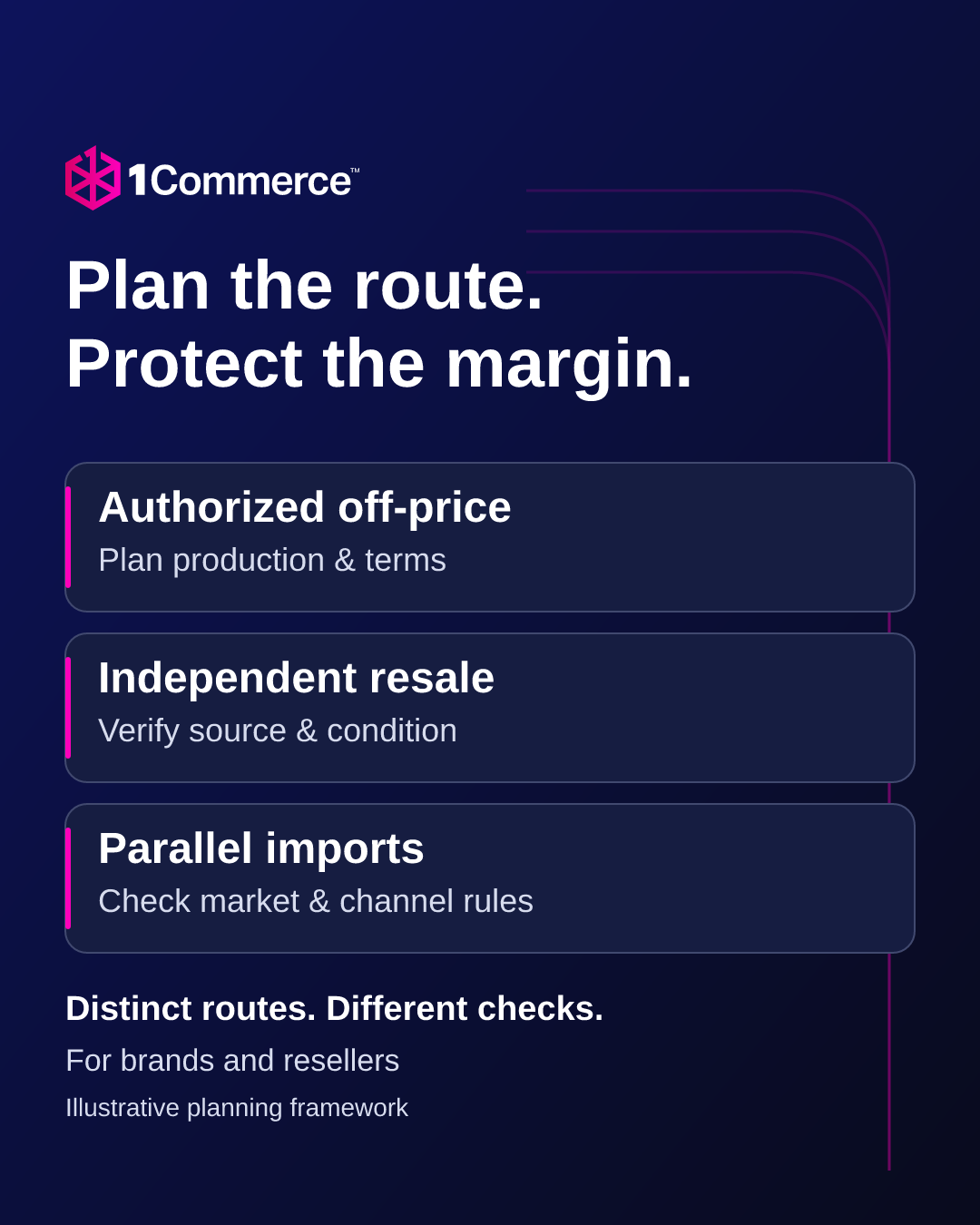
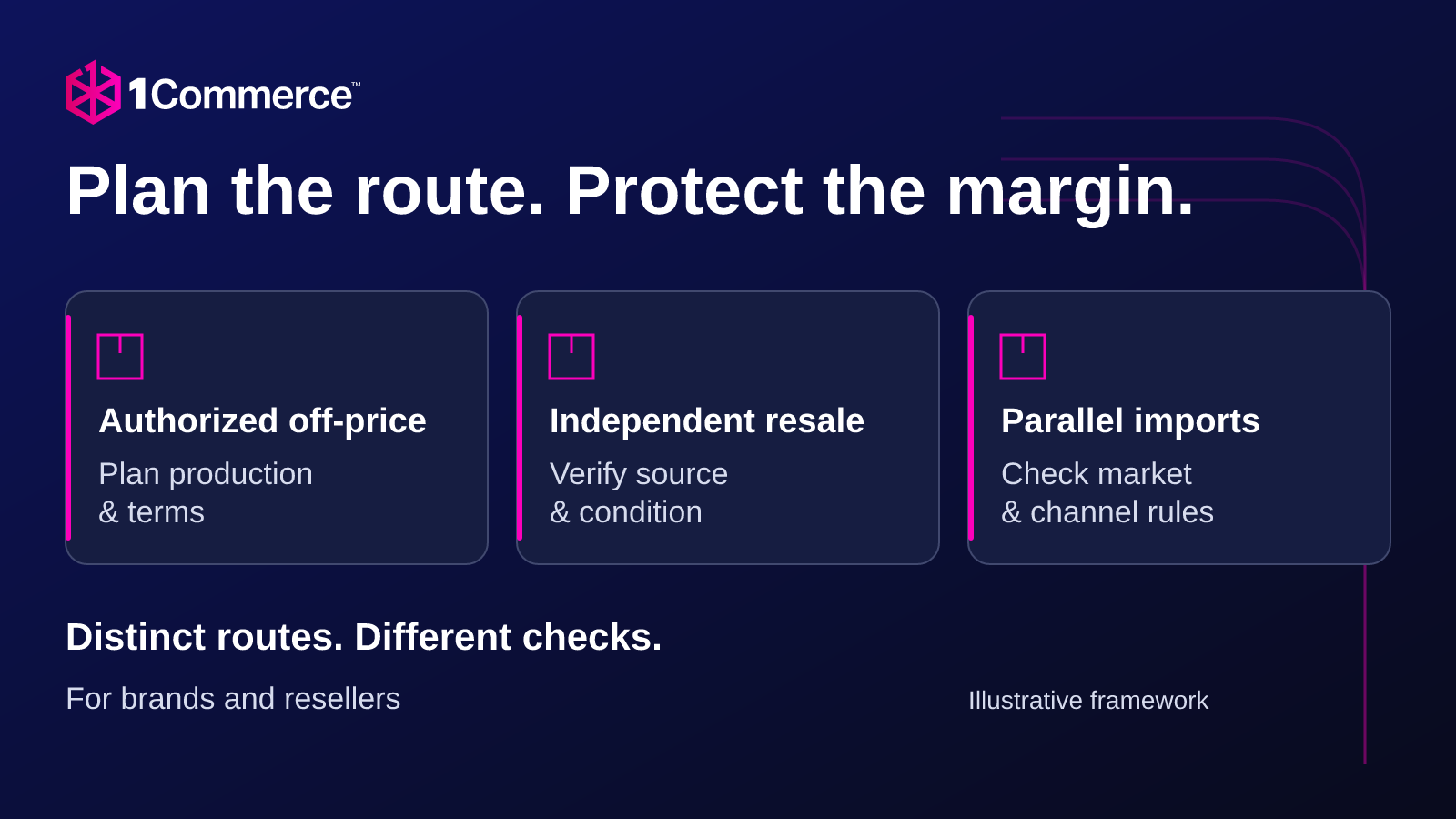
For planning purposes, separate four routes:
| Route | What distinguishes it | Decision before committing inventory |
|---|---|---|
| Deliberately supplied off-price assortment | Product is made or sourced for that channel through an agreed commercial arrangement. | Define assortment, quality, economics and how the offer differs from other channels. |
| Authorized clearance or overstock sale | Existing inventory moves through a route the seller has agreed to use. | Specify the lot, condition, buyer, timing and any applicable contractual restrictions. |
| Independent resale | A subsequent seller offers inventory it acquired, without necessarily being a brand-authorized dealer. | Verify provenance, condition, representations and destination requirements. |
| Cross-border parallel imports | Genuine goods enter a country outside the right-holder’s authorized import route. | Establish the relevant legal, customs, product and marketplace requirements for that route. |
These categories can overlap. A clearance lot may later be resold or exported. They are a working map for asking better questions, not labels that establish a transaction’s legality or a seller’s authorization.
A premium brand can manage markdowns and protect its distribution
Lululemon’s fiscal 2025 annual report, covering the year ended February 1, 2026, says it uses outlets to sell slower-moving inventory and inventory from prior seasons at discounted prices. The same report describes wholesale relationships with partners including fitness studios, athletic organizations and university campus retailers.[2]
It also states the commercial downside: inventory above demand may lead to write-downs or discounted sales, hurting gross margin and potentially the strength and exclusivity of the brand.[2]
That is a real tension worth managing. Recovering cash and preserving brand positioning can pull in different directions. The existence of an outlet channel does not establish that a brand authorizes an unrelated reseller, and a discounted listing does not explain how that seller acquired the goods.
Lululemon’s separate Resale + Brand Protection page recognizes that purchasers can decide what to do with products they own, while stating that the company does not support people acquiring its products to resell at an elevated price point. It also describes its anti-counterfeiting efforts.[3] Those are the company’s stated positions; they are not proof about an individual seller’s inventory.
The strategic lesson is to plan for secondary channels while retaining standards for authenticity, customer communication and distribution. There is no need to speculate about a board’s private beliefs to make that case.
Genuine, authorized and eligible are separate checks
The World Trade Organization defines parallel imports as products made legally abroad and imported without the intellectual-property right-holder’s permission. Its glossary explicitly notes that some countries allow this and others do not.[4]
That distinction matters. Parallel imports and counterfeits are not interchangeable terms. But “genuine” alone does not settle whether a specific cross-border transaction is permissible. Obtain route-specific advice where needed; this article does not establish legal clearance for a shipment.
Marketplace eligibility is another question. Amazon’s own reselling guide advises sellers to keep sourcing records, including purchase orders, invoices and receipts, and to check category approval requirements before sourcing inventory.[5] That guidance is not a promise that any particular receipt will satisfy a later verification request.
EBay’s counterfeit policy says sellers may list an item only when they are certain it is genuine and it complies with the applicable policies. Its documentation guidance includes invoices from brands or authorized distributors, serial numbers and other relevant authenticity records.[6]
A reseller therefore needs to answer three questions independently:
- What are the goods? Match the physical stock to its identifiers, condition, packaging and supporting documents.
- What transaction and representations are permissible? Check the proposed route and avoid implying brand authorization that has not been established.
- Can this seller offer this product here? Verify the actual marketplace, category, account and listing requirements before buying stock against an assumed route.
A warehouse receipt answers only part of the first question. An attractive resale price answers none of them.
Make the inventory decision at lot level
Here is a proposed operating framework for brands and legitimate resellers. It is a planning method, not a platform rule or a claim about any named company’s process.
1. Build a file that follows the lot
Identify the seller and buyer, SKU or product identifiers, quantities, purchase documents, condition and any missing packaging or labels. Record who can resolve discrepancies. For products where shelf life or batch traceability matters, include those fields before valuation.
Do not let a blended pallet description become the only record of what was bought. If the documents and physical stock cannot be reconciled, segregate the uncertain units while the discrepancy is resolved.
2. Define the destination before the discount
Write down the intended country, channel and customer offer. Review applicable agreements and marketplace requirements. Identify who handles listing accuracy, returns, warranty representations and customer questions.
For brands, this makes the proposed clearance route explicit. For resellers, it tests whether the commercial opportunity has a usable route to market. Any geographic or downstream restrictions need appropriate legal review; writing them into a spreadsheet does not make them enforceable.
3. Compare net recovery with the cost of waiting
For a brand, estimate proceeds from the lot after incremental preparation, transport and transaction costs. Compare that with realistic alternatives: holding the inventory, a controlled markdown or another permitted disposition route. Include timing and the potential conflict with existing channel commitments, rather than comparing headline selling prices alone.
For a reseller, start with expected realized selling proceeds, then subtract acquisition cost, inbound freight, duties where applicable, inspection, preparation, marketplace fees, fulfillment, storage and expected returns. Avoid counting the same cost twice. Stress-test the result for slower sell-through or a route becoming unavailable.
The useful output is a decision with assumptions attached—not a margin percentage detached from the stock’s condition and selling constraints.
4. Keep commitments and exceptions visible
Reserve units already promised elsewhere. Keep stock whose documentation or condition is unresolved separate from sellable inventory. Agree who can release a held lot and what evidence they need.
Track the original lot through subsequent movements and returns. When an exception occurs, the team should be able to identify the affected units without freezing every SKU from the supplier.
A hypothetical lot decision
Imagine a home-goods brand with 1,000 discontinued travel mugs. It has committed 250 to an existing retail order. Another 100 have damaged outer cartons. A reseller offers to buy the remainder for marketplace sale.
The first decision is quantity: 650 units are outside those two exceptions, subject to inspection and the rest of the checks. The committed 250 stay reserved. The 100 with damaged cartons need a separate condition and disposition decision rather than being quietly included as ordinary new stock.
Before agreeing a price, the reseller checks the proposed listing route and obtains documents that identify the goods and supplier. Both parties clarify the customer offer and responsibility for returns. The reseller then tests the economics using realistic selling prices and costs, rather than the brand’s original retail price.
No saving or successful marketplace approval is assumed here. The example shows how a commercial conversation becomes a defined lot, a documented route and a decision each side can defend.
Give secondary trade an operating plan
A brand can pursue disciplined distribution and still recognize legitimate resale. A reseller can pursue an opportunity while respecting authenticity, accurate listings and channel requirements. Neither position requires treating all secondary trade as misconduct—or treating every available lot as a good buy.
1Commerce supports resellers and parallel trade, and helps resellers navigate marketplace complexities. For brands planning an inventory exit and resellers assessing a new lot, start with the same practical questions: what is the stock, where can it go, what evidence follows it, and what remains after the costs?
Bring those questions into the operating conversation before the purchase order is signed.
Sources
- TJX: How We Do It, updated June 2026; retrieved November 9, 2026.
- Lululemon fiscal 2025 annual report, year ended February 1, 2026; report signed March 17, 2026; PDF pages 11 and 17.
- Lululemon: Resale + Brand Protection, undated; retrieved November 9, 2026.
- WTO glossary: parallel imports, undated; retrieved November 9, 2026.
- Amazon: Guide to reselling in Amazon stores, displayed date September 17, 2025; retrieved November 9, 2026.
- EBay: Counterfeit policy, undated; retrieved November 9, 2026.