Before putting a holiday order deadline in checkout, ask the warehouse which dispatch will carry those orders. The carrier’s recommended shipping date is one input. Your order deadline must also leave room for review, picking, packing and physical acceptance.
On September 22, USPS published its 2026 holiday recommendations. For the contiguous United States, it recommends sending Ground Advantage and First-Class Mail by December 17, Priority Mail by December 18, and Priority Mail Express by December 19 for expected delivery before December 25. These are carrier recommendations, not approval of a merchant’s order deadline. USPS announcement.
Start with the dispatch you can actually use
Use the lower-48 dates only for the geography they describe. USPS publishes separate information for other destinations and notes that delivery depends on origin, destination, acceptance time and other conditions. Recheck the current table before publishing customer wording. USPS holiday shipping dates.
Build one working row for each combination of fulfillment location, service, destination group and eligible products. A single sitewide date hides differences the operating team needs to see.
| Decision | Record before approving the cutoff |
|---|---|
| Which orders qualify? | Location, service, destinations, products and exclusions |
| Which dispatch will carry them? | Actual operating date, local cutoff time and acceptance arrangement |
| What must finish first? | Order review, release, picking and packing allowances |
| What could consume the allowance? | Address questions, inventory exceptions and other known holds |
| Who can change the promise? | Named owner, trigger and customer communication path |
For a specific lane, the USPS service lookup asks for origin and destination ZIP codes, mailing date and mailing time. Use the actual planned handoff inputs; this article does not establish a lane-specific delivery result. USPS service commitments lookup.
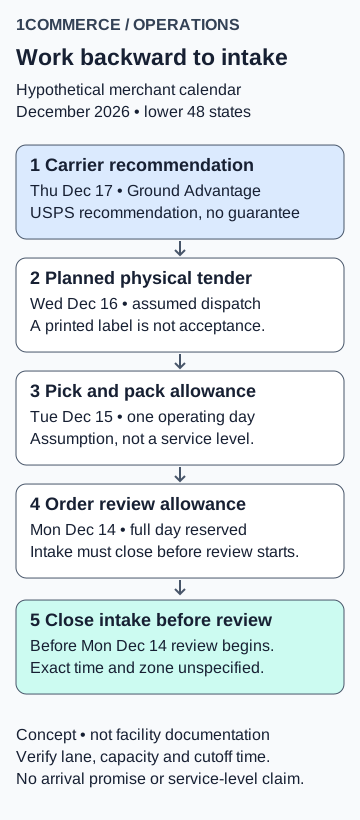
Work backward through your operating calendar
Hypothetical merchant example: Assume a warehouse plans to dispatch Ground Advantage orders only on Wednesdays. Its chosen tender before the Thursday, December 17 recommendation is Wednesday, December 16. Assume one full operating day for picking and packing and one full operating day for order review. The warehouse operates Monday through Friday for those activities.
| Illustrative date | Reserved activity |
|---|---|
| Monday, December 14 | Review and release eligible orders |
| Tuesday, December 15 | Pick and pack released orders |
| Wednesday, December 16 | Tender packages through the planned dispatch |
| Thursday, December 17 | USPS lower-48 recommended send-by date |
To reserve all of Monday for review, intake must close before that review period begins. The merchant still needs to specify an exact time and time zone. Advertising “order by December 14” without that time could admit orders too late for the assumed full day of review.
These dates and processing allowances are illustrative merchant assumptions, not USPS processing standards or 1Commerce service levels. They do not promise arrival. Any additional exception allowance moves intake earlier; it cannot be inserted after the last usable dispatch.
Give exceptions an owner before publishing the date
Try the row against two hypothetical products: an ordinary stocked item and one requiring extra preparation. If the second item cannot meet the same handoff, give it a separate eligibility rule or earlier cutoff. Do not make the warehouse discover the difference after the promotion has launched.
Ask the operations owner to identify the evidence they will retain for carrier acceptance. Label creation alone should not close that check. Ask the customer experience owner what happens when an eligible order misses the planned tender: who reviews it, who contacts the buyer and who updates the displayed promise if the assumption no longer holds?
The broader service-promise operating guide covers ownership and handoffs. For this holiday decision, bring the carrier table and the facility calendar to the same review. Approve the intake time only when someone can explain every step between checkout and acceptance.