A correct compare-at value in your product data does not settle what a shopper sees. Before using that value in campaign messaging, ask the team to show the source, the sharing setting and the observed shopping experience for the same variant and market.
Shopify’s October 9, 2026 announcement says Shopify Catalog can share compare-at prices with AI shopping agents, with a control in admin. That creates a specific merchandising check: decide which price evidence you need before describing an offer on a channel. Shopify announcement.
Check the setting and the field separately
Shopify’s current help page describes a List price selector in Catalog channel mapping. Choose Price to use the current price as the list price, or Compare-at price to use a compare-at value that exceeds the current price. An eligible compare-at value uses the list_price field in the Universal Commerce Protocol Variant specification. Changes are processed with a delay, and Catalog preview does not exactly predict AI-channel display. Shopify Catalog mapping documentation.
Those boundaries matter when deciding whether the audit is complete. Record the observed setting rather than assuming a product edit changed it. A preview can support a finding about the preview. It cannot fill an empty observation for another surface.
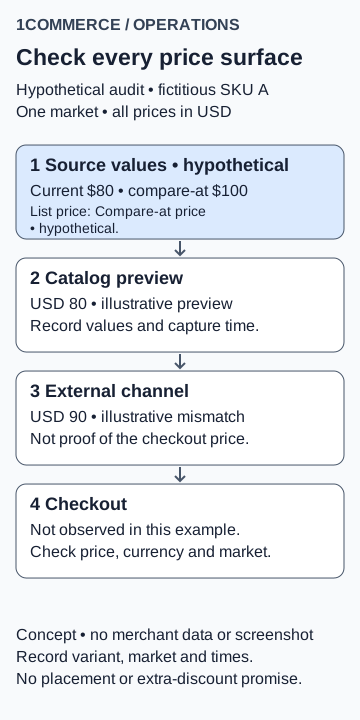
Use one evidence card per variant and market
Keep these six columns together. A row is useful only if the team can tell whether each observation concerns the same item, currency and context.
| Column | What the auditor records |
|---|---|
| Product context | SKU, variant, market and observation time |
| Current price | Value, currency and source location |
| Compare-at value | Value, currency and source location |
| Sharing control | Observed setting and capture time |
| Catalog observation | What the preview actually showed and when |
| Shopper observation | Named external surface and checkout result, each timed separately |
Use “not observed” when the team has no evidence. If a channel does not show a price, record that limited observation without calling it a universal channel failure. Preserve enough context to repeat the check, including the destination market and selected variant.
Give merchandising ownership of the source values and their justification. Give ecommerce operations ownership of the observation record and unresolved differences. The person approving promotional wording should be able to see both.
Walk a mismatch through the card
Hypothetical example: A fictional variant has a current price of USD 80 and a compare-at value of USD 100. The List price choice is Compare-at price. Under the documented higher-than-current-price condition, the compare-at value qualifies for sharing. This is an illustration, not a merchant configuration or observed transmission.
Suppose your illustrative audit then records USD 80 in Catalog preview but USD 90 on one external shopping surface. Leave checkout marked “not observed” until it is checked. Do not close the row because the preview looks right, and do not infer what the buyer would pay from the external display alone.
First compare the variant, currency, market and capture times. Then assign the discrepancy to an owner who can investigate the relevant source or channel. Keep the row open until there is a repeatable observation or an explicit limitation. Avoid repeatedly editing prices merely to make one screenshot agree.
The USD 100 comparison also does not establish a further discount at checkout. Treat the reference price, displayed selling price and any checkout promotion as separate observations. Have the responsible commercial and legal owners assess promotional use; this audit does not determine whether a price comparison is suitable in a particular market.
Define what a completed audit means
A completed row should answer three questions: what did we configure, what did we observe, and what remains unverified? It should never turn “eligible to share” into a claim of placement, ranking or sales.
Start with a small, named sample that includes a higher compare-at value and a case that does not meet that condition. Record the current state before proposing any change. Use the promotion operations checklist for the wider launch review, and keep this price card beside it. The buyer-facing offer deserves evidence from the surface on which the buyer encounters it.